What Is the Darkest Legal Window Tint in New York?

What is the darkest legal window tint in New York? Since the regulations for window tinting in New York are stricter than those in most states, especially the core requirement that the light transmittance of the front windows must reach 70%. If the tint is applied too deeply, not only will you be stopped by the police, but you will also fail the annual inspection directly, resulting in additional costs for removing and reapplying the tint. Therefore, before choosing a tint, figuring out "what is the darkest legal tint for car windows in New York" is not only a compliance issue, but also an important first step to avoid trouble, control the budget, and ensure a long-term usage experience.
NYS Legal Tint Limits Explained
The window film regulations in New York are among the strictest in the entire United States. Therefore, before applying the film, it is essential to first determine how deeply each window can accommodate the film.
1. What is VLT? Why does a lower value result in a darker appearance?
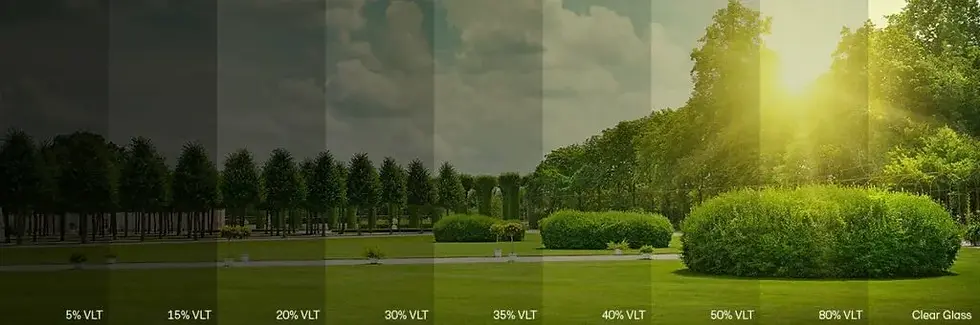
VLT stands for "Visible Light Transmittance". It indicates the percentage of light that can pass through the glass and the film. In simpler terms:
70% = Very transparent, it looks almost as if there is no film attached.
35% = The visibility becomes significantly reduced, but the interior of the vehicle can still be seen.
20% = Dark privacy mode, not very clear view inside the vehicle.
5% = limousine depth, almost completely black.
New York uses this figure to determine whether you are "legitimate" or not. The lower and deeper the figure is, the more likely you are to be in violation of the law.
2. The front window must have a VLT of ≥ 70%
The regulations for the front windows in New York are very strict. If the light transmittance of the front side glass on both sides is less than 70%, it will be regarded as illegal. That is to say: The front windows cannot have 35%, 20%, or 5% transparent films applied; only 70% or higher transparent films can be used. This is the most common problem area when it comes to applying films on the front windows in New York.
3. Rear side windows have no restrictions; you may tint them as darkly as you wish.
Unlike the front windows, the rear side windows have no minimum VLT requirements at all. You can apply 35%, 20%, or 5% without any problem. But the prerequisite is that the vehicle must have left and right exterior rearview mirrors. Therefore, many cars in New York have a combination of "shallow front windows and deep rear windows".
4. There is no depth restriction for the rear windscreen either.
The regulations for the rear windshield are the same as those for the rear side windows. You can apply dark privacy films if you wish, as long as you have a rearview mirror. Therefore, 20% or 5% are the most common choices for models like NYC SUVs and Teslas.
5. The front windscreen may only be applied to the narrow strip area at the top of AS-1.
The front windshield cannot have dark films applied. This is a uniform regulation in New York. The only exception is a small strip above the AS-1 line on the glass. If there is no AS-1 marking, it should be limited to a distance of approximately 5 inches from the upper edge of the glass. Anything beyond this range will be regarded as illegal.
6. During the annual inspection, the windscreen light transmission rate will be tested; failure to meet standards will result in immediate rejection.
The annual inspection in New York will use a photometer to measure the VLT of the front window. It's not about the appearance, but a precise digital measurement. As long as the data is below 70%:
Directly fail the annual inspection
Must remove the film
Re-perform the annual inspection, which is a waste of time and money
Many car owners only discovered that "the sticker on the front window was too thick" during their annual inspection.
The deepest legal tinting in New York is as follows: the front window can be tinted to 70%, and the rear window can be tinted up to 5%. This "light tinting on the front and deep tinting on the rear" configuration is the most common, safest and easiest to pass the annual inspection in all of New York.

Front side window (maximum legal depth: 70% VLT)
New York has the strictest requirements for the front windows, with the light transmittance having to be maintained at 70% or above. This is the maximum legal depth that the front windows can be treated to. Dark films with a depth of 35%, 20%, or 5% are not allowed. A 70% transmittance appears almost transparent, but if you choose ceramic or nano-ceramic materials, you can still achieve significant heat insulation effects.
Side window at the back (Maximum legal depth: 5% VLT)
There is no light transmission restriction in the rear section, so the owner can choose the depth of 35%, 20%, or even 5% (for limousines) according to their preference. A 35% depth appears natural and harmonious, a 20% depth provides stronger privacy, while a 5% depth almost completely blocks the interior and is a very common combination in NYC.
Rear Windshield (Maximum Legal: 5% VLT)
The rear windshield also has no limit, and it can be adjusted to a depth of 20% or 5% in unison with the rear seats. Dark rear windshields not only enhance privacy but also make the overall visual appearance more consistent. They are particularly popular among Tesla, SUV, and large vehicle owners.
Front windshield (only for the top band of AS-1)
The front windshield cannot have dark films applied to it. The only legal area for applying films is the narrow strip above the AS-1 marking, which is used to block sunlight. This will not change the overall appearance of the front windshield nor will it affect the driver's view.
Table: Legal vs. Illegal Tint Levels in NY
VLT Level | Front Windows (Driver / Passenger) | Rear Side Windows (Rear Passenger) | Rear Windshield | Notes |
70% | ✔ Legal | ✔ Legal | ✔ Legal | The only front-window depth that passes NY inspection. |
35% | ✘ Illegal | ✔ Legal | ✔ Legal | A common rear-window choice in NYC, but illegal for front windows. |
20% | ✘ Illegal | ✔ Legal | ✔ Legal | High privacy; may appear darker at night. |
5% (limousine) | ✘ Illegal | ✔ Legal | ✔ Legal | Extremely dark; recommended only for rear windows. |
The front window can only be used at 70% because the annual inspection will measure the light transmittance.
There is no depth limit for the rear seats and the rear windshield, so 35%, 20%, and 5% are all legal.
A large number of vehicles in New York adopt the "front shallow and rear deep" configuration, which is based on this set of regulations.
Why Many Cars Fail NYS Inspection?
Many car owners think "If I apply 70% of the film, it must be legal", but when it comes to the annual inspection, they are found to be over the limit and have to remove the film and reapply it. The reason for this situation is not only the depth of the film application, but also related to various factors such as the original vehicle glass, the type of film material, and the construction process.
The original factory glass has different properties. For some models, the light transmission rate is inherently lower.
The light transmittance of the original factory glass varies greatly among different brands and models. For some vehicles, the original factory VLT of the front windows is close to 75% to 78%, and even after applying a 70% film, it still remains within the compliant range. However, for other vehicles, the original factory VLT is only 70% to 72%. When applying the same 70% film, the light transmittance will drop to around 65%, thus becoming non-compliant. This is why merely looking at the "depth of the film" is not sufficient for accuracy.
Even if a 70% coating is applied, the final value may still be lower than 70%.
After applying the film, VLT is "original glass × film material VLT". For example: Original glass 72% × Film material 70% ≈ 50% (completely non-compliant).
This is also a point that many car owners find confusing: "Even though we have applied the sticker at 70%, why did we still fail the annual inspection?"
The factory-fitted front windscreen on models such as the Tesla tends to be rather dark, making it more prone to non-compliance

Many Tesla owners discovered this after their annual inspections failed. The factory-installed front windows of Tesla vehicles are actually darker than those of ordinary vehicles. This means:
Before applying the transparent ceramic film, it is necessary to measure the VLT first.
After application, it must be confirmed whether it remains within the 70% legal range.
Many owners of Model 3/Y vehicles reported that after the 70% check, the remaining percentage was only 65% to 68%, which led to a direct failure of the annual inspection.
The most common cause of failure is the failure to conduct a VLT inspection before construction.
Many ordinary film coating stores in New York do not conduct VLT tests on their own. If they only follow the "marked values on the film material" for construction and do not measure the original factory glass, it is very likely to result in:
After construction, it fails to pass the annual inspection.
The owner has to remove the film and redo the work.
There is a waste of both time and money.
The core value of a professional store lies in the VLT test conducted before the film application.
The annual inspection spectrometer is much more rigorous than the naked eye. The naked eye cannot determine compliance.
Many car owners thought: "It doesn't seem very deep, so it should be fine." However, the annual inspection uses a photometer which measures precisely to percentages. As long as the result is below 70%, even if it looks very shallow to the naked eye, it will fail immediately. Therefore, during construction in New York, one cannot rely on visual judgment or guesswork based on experience; instead, measurements must be taken using instruments.
Why T-House Is the Trusted Choice for Legal Tint

The construction process of T-House is centered around "compliance first", which enables it to more reliably meet the strict light transmittance requirements of New York. Before the construction, technicians will first measure the original VLT of the vehicle using professional instruments, rather than just relying on the nominal data of the film. This step can prevent situations where the original factory glass appears too dark but still has a 70% film applied, ultimately resulting in a failed annual inspection. The team has received official training from 3M, XPEL, and Llumar, and is more familiar with the optical superposition of different film materials and the changes in VLT for various vehicle models. They can estimate the actual light transmittance after the construction based on the vehicle characteristics.
T-House employs a dust-free and temperature-controlled construction room to minimize the fitting errors caused by dust and temperature differences, making the VLT more stable and having less impact on the legality of the front windows. For models with darker original factory glass such as Tesla, BMW, and Mercedes, they have extensive experience and can clearly inform the risks before construction and recommend the most suitable legal configuration. Additionally, T-House uses high-grade transparent ceramic films, enabling the front windows to maintain 70% compliance while still achieving significant heat insulation effects.
The entire quotation process is transparent. No illegal measures will be recommended, nor will drivers be encouraged to sacrifice legality for the sake of appearance. All suggestions are based on regulations, vehicle models and annual inspection requirements, allowing car owners to confidently obtain "attractive, heat-insulating and legal" tinting results.
FAQ: Darkest Legal Tint in New York
1. What is the darkest legal window tint in New York?
The front windscreen may only be tinted to a maximum of 70% visible light transmission (VLT). There are no restrictions on rear windows or the rear windscreen, which may be tinted as dark as 5%.
2. Is 35% legal in NY?
The front window is not compliant. The rear side windows and rear windscreen are compliant.
3. Can I use 20% on my rear windows?
Certainly. There is no minimum VLT requirement for rear windows in New York, so 20%, 35%, and 5% tints are all legally permissible.
4. Does NY inspection check tint?
The inspection will be conducted. During the annual inspection, a photometer is used to measure the light transmission rate of the front windscreen. A reading below 70% will result in an immediate failure.
5. Can Tesla pass inspection with tint?
Certainly, but proceed with caution. Tesla's factory-fitted front windscreen is inherently dark, so it is imperative to measure the original VLT before applying 70% tint to ensure compliance with regulatory standards.

If you are considering applying a film and want to ensure that your vehicle remains compliant in New York for an extended period, confirming the VLT values before the installation will make the entire process much more reassuring. You can first obtain a transparent quote for the film, understanding the actual performance of different depths and film materials under the regulations; or you can schedule a visit to the store for a VLT test to confirm that the front windows still meet the 70% legal standard after the film is applied. If you have any questions about the vehicle model, annual inspection, or depth combination, you can also communicate with the certified technician to obtain more accurate advice based on your driving area, original vehicle glass and insulation requirements. This way, you can make the most suitable film application choice in a clear and stress-free manner.
📍Address :
15-45 128th Street,
Flushing, New York
United States
📩 E-mail :thouseny1@gmail.com
📞 Telephone : (845) 501-3559
🌐 Website: https://www.thouseny.com/


Comments