What Window Tint Is Legal in New York?

What window tint is legal in new york? As the window tinting regulations in New York are stricter than in most states, especially the 70% VLT limit for the front windows. To avoid failing the annual inspection, being pulled over by the police, or having to remove and reapply the tint due to incorrect depth, it becomes particularly important to understand the legal standards for window tinting in New York. The following content, from a professional perspective, will quickly guide you on which shades are legal and which ones to avoid in New York, and help you make safer and more compliant decisions when choosing a tinting shop.
NY Window Tint Law Breakdown

The window film regulations in New York are among the strictest in the United States, particularly regarding the light transmission requirements for the front windows. Understanding these rules is crucial to avoid failing annual inspections, receiving fines, and applying the wrong type of film.
① The front window must have a visible light transmittance (VLT) of at least 70%
The strictest regulation in New York is regarding the front side windows. The law stipulates that the visible light transmittance (VLT) of the front side windows must be 70% or higher.
What is VLT?
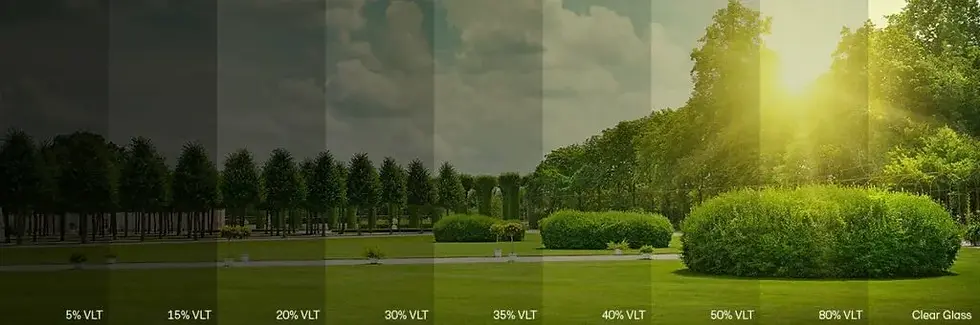
VLT (Visible Light Transmission) = Visible light transmittance
The higher the number → The more transparent
The lower the number → The darker the color (for example, 20% is darker than 70%)
A 70% light transmission rate is very high, so any film that causes a "noticeable darkening" is almost impossible to be used on the front window. This is also the reason why window tinting in New York is regarded as strictly regulated.
② Rear Windows and Rear Windshield: No minimum VLT limit, but dual side rearview mirrors are required
In New York, any depth of tint is allowed for the rear side windows, including 35%, 20%, and 5% (commonly known as limousine tint). However, there is one prerequisite: the vehicle must have functioning rearview mirrors on both the left and right sides. This is to ensure that the rear view remains safe even with dark tinting.
③ Front Windshield: Only AS-1 Stripes Are Permitted
Dark tinting film is not allowed on the front windshield in New York. The only exception is that a narrow strip of dark tinting film can be applied above the AS-1 line.
The AS-1 line is usually located at the upper edge of the front windshield and marked accordingly. If there is no marking, the area up to a maximum of 5 inches is considered the permissible area for application.
④ Front Windshield VLT will be Compulsorily Inspected during Annual Vehicle Inspection
Since 2017, New York has included VLT measurement in the mandatory annual inspection program. That is to say:
The annual inspection officer will use a photometer to measure the front window. If it is less than 70%, the annual inspection will fail directly. You will not be able to obtain the annual inspection sticker. The film must be removed or reapplied and then re-inspected.
Many car owners only discover that they have "illegally affixed stickers" on the day of the annual inspection, so choosing a compliant and deep-level option is very important.
⑤ Law enforcement agencies may conduct stops due to insufficient visibility
In addition to annual inspections, New York police have the authority to conduct vehicle stops for the following reasons:
The front window is too dark, making the driver's face invisible.
Insufficient lighting at night poses safety hazards.
Visibility decreases in rainy or bad weather.
Once a violation is confirmed, the police can issue a ticket and require the vehicle owner to make corrections. The enforcement intensity varies slightly in areas such as Flushing, Manhattan, and Brooklyn, but a vehicle with overly dark front windows can be stopped at any time.
Why does New York have such strict regulations on front windows?
The main reasons include:
Pedestrian safety requires higher visibility.
With high traffic density, it is necessary to maintain a better line of sight.
Law enforcement needs to clearly see the driver's condition.
Dark films can easily cause accident risks at night.
Therefore, the regulations are not arbitrary but are formulated based on safety considerations.
Real Examples of Legal vs Illegal Tint in New York
The biggest challenge of the New York window tinting regulations lies in the fact that: The front windows must have a VLT of ≥70%, while for the rear seats, there is almost no limit. However, many car owners have no idea about these numbers and don't understand what 70%, 35%, 20%, 5% actually represent in terms of tint depth.
Here, we will use the most common VLT depth as an example to enable you to quickly identify which ones are legal and which ones must be avoided at a glance.

VLT Level | Front Windows | Rear Side Windows | Rear Windshield | Compliance Notes |
70% | ✔ Legal | ✔ Legal | ✔ Legal | The only legal option for front windows |
35% | ✘ Illegal | ✔ Legal | ✔ Legal | Common depth for rear windows |
20% | ✘ Illegal | ✔ Legal | ✔ Legal | Strong privacy effect |
5% | ✘ Illegal | ✔ Legal | ✔ Legal | Limousine tint; rear windows only |
70% VLT → Completely legal (the only compliant option for the front window)
70% appears to be very close to being transparent.
Heat insulation mainly relies on the technology of ceramic membranes and nano-ceramic membranes, rather than the shade of color.
This is the only legal option for the front side windows on both sides of the vehicle.
Annual inspection must pass.
Suitable for: All New York car owners who wish to comply with regulations and also aim to enhance the insulation performance.
35% VLT → Rear seat is legal, but the front window is illegal.
35% falls into the medium-depth category
Appears significantly darker but still maintains good visibility
Can only be applied to the rear and rear windshield
If applied to the front window → Passing the annual inspection will fail + The police can stop and inspect
Suitable for: The rear areas of SUVs, family cars, and vehicles used by Uber/Lyft
20% VLT → Dark color. Only available for the rear seats.
20% High level of privacy
The interior is hardly visible from outside the vehicle during the day
It can only be used for the rear side windows and rear windshield in New York
The front windows are definitely illegal
Suitable for: The rear area where one desires to enhance privacy and protect personal belongings
5% VLT (commonly known as limousine tint) → All front windows are illegal
This is the deepest level, and it is almost impossible to see inside the vehicle.
It is commonly found in luxury cars or vehicles with high privacy requirements.
It is 100% illegal on the front window in New York.
If it is attached to the front seat, it will immediately fail the annual inspection and pose a safety hazard at night.
Suitable: Only for the rear seats; and it requires the use of both side rearview mirrors.
Does Tint Affect NYS Inspection?

The New York State Inspection (NYS Inspection) will specifically test the light transmittance of the front windows. Therefore, applying tinted film will indeed affect the inspection results. The testing method is not "visual inspection", but rather uses a formal photometer to measure VLT (visible light transmittance). As long as the measured value is below 70%, the front side windows will be judged as unqualified, and the inspection will fail immediately. Many car owners think that "it doesn't look too dark" will allow them to pass, but the photometer is very precise and there is no way to take a chance.
If the window film is applied too thickly and results in a failed annual inspection, the owner must remove the film from the front window, reapply a legally compliant window film with a 70% light transmittance, and then return to the annual inspection station for re-inspection. This will consume additional time and costs. Moreover, this regulation applies to all vehicle models, including high-end vehicles like Tesla. Especially for Tesla's original front windows, which have a slightly lower light transmittance, if a dark film is applied, it will almost certainly fail to meet the standards. Many owners only realize that their window films are not compliant on the day of the annual inspection. Therefore, it is crucial to have the VLT tested at a professional store and choose the appropriate depth in advance to avoid trouble.
Area Enforcement Differences Across New York
1. Manhattan
The traffic density in Manhattan is high and the police force is concentrated, so the inspection of window films on the front windows is the most stringent. Police are more likely to stop drivers for "invisibility of the driver's face" during the day or at night, especially in commercial areas, tunnel entrances and busy thoroughfares. As long as the depth of the front window is less than 70% VLT, it is almost impossible not to be noticed. Therefore, car owners who frequently drive in Manhattan must adhere to completely compliant window transparency rates.
2. Queens / Flushing
There are a large number of annual inspection stations in Flushing, with up-to-date equipment and very strict inspections for "front window VLT". Many car owners discovered for the first time that their window films were not compliant here. Although road inspections during normal times are relatively rare, they may still be checked for the depth of the front windows during peak hours or on sections with a high density of Uber/Lyft vehicles. For Flushing car owners, transparent ceramic films (70%) are almost the default safe choice.
3. Brooklyn
The enforcement intensity in Brooklyn is in between that of Manhattan and Queens. Some communities are more lenient, but in popular areas, during night patrols, and on major roads, regular checks are conducted on the visibility of the front windows. The risks of using windows with depths of 35% and 20% still exist, especially when the night light is poor, and they are more likely to be stopped. Owners of vehicles with variable driving routes should try to abide by the 70% limit.
4. Long Island
Long Island, being an area with a suburban environment, has a lower density of police forces and thus a lower probability of being stopped. However, the film application regulations of NYS still fully apply. The annual inspection still measures the light transmittance of the front window, and if it is below 70%, it will definitely fail. Therefore, even in areas with more lenient law enforcement, the front window must still maintain the legal depth; otherwise, the same problems of having the film removed and re-inspection will occur.
How to Choose a Legal Tint That Still Looks Good in New York?
When applying window films in New York, the biggest challenge is to achieve both legality and good appearance, high insulation performance, and high practicality. The front windows must meet the strict requirement of 70% VLT. However, this does not mean that the final effect of the vehicle will be "totally lacking in texture". By correctly selecting the tinted film material and thickness, the entire vehicle can still maintain compliance while having a coordinated appearance and strong insulation performance.
a. For the front window, it is recommended to use a 70% transparent ceramic film
Many car owners mistakenly believe that "transparent film = no effect", but this is an outdated notion. Modern high-grade ceramic films and nano-ceramic films, even with a 70% light transmittance, can still provide:
Excellent heat insulation performance
High infrared radiation blocking ability
Clear vision
No metal components, does not affect signal transmission
This ensures that the front window is fully compliant while maintaining comfort levels, making it the best choice for New York car owners.
b. The rear row can be paired with a depth of 20% to 35%
There is no VLT limit in the rear row, so you can choose as per your needs:
35%: Visually natural, suitable for family vehicles
20%: Offers stronger privacy, a mainstream choice in Flushing and NYC
5%: Extremely deep, only suitable for owners with extremely high privacy requirements
The combination of 70% for the front window and 20% or 35% for the rear window is the most common and harmonious overall appearance in New York.
c. The heat insulation effect does not depend on the depth, but on the membrane material technology
This is a crucial point that many car owners are unaware of. Dark colors do not necessarily provide insulation, but ceramic films definitely do. The insulation performance of transparent ceramic films is usually significantly better than that of dark tinted films. Explanation:
Dyed film → Absorbs light by color, providing weak heat insulation
Ceramic membrane → Utilizing nanostructures to block infrared rays, it has excellent heat insulation properties.
This means that you can maintain the legal front window depth while still achieving the same level of comfort as in the rear seats.
FAQ:What Window Tint Is Legal in New York
Q1. What tint is legal in NY?
New York regulations: The front window must have ≥ 70% VLT (almost transparent); there is no minimum VLT requirement for the rear side windows and the rear windshield; The front windshield can only have the band above the AS-1 line. In other words, any depth of rear window is acceptable, but the front window can only use high-transparency film.
Q2. Is 35% tint legal in New York?
The rear is legal, but the front window is illegal.
35% falls into the medium-depth category and appears significantly darker. This coating can only be used on the rear side windows and the rear windshield in New York, but not on the front windows.
Q3. Can you get pulled over for tint in NY?
Yes. If the police cannot clearly see the driver's face or the conditions inside the vehicle during the day or at night, they have the right to conduct a stop-and-search. Especially on the main roads of Manhattan and Brooklyn, having a 35% or 20% tint on the front window makes it very likely to be stopped.
Q4. Does tint fail inspection in NY?
Yes. The annual inspection in New York will use a photometer to measure the light transmittance of the front window.
Less than 70% → Direct failure
Regardless of the vehicle model, the membrane material, or the brand, if the numerical values do not meet the standards, it will not be approved.
Q5. Can Tesla get legal tint in NY?
Yes. The original window glazing of Tesla has a slightly lower light transmittance, so the application of window films must be very careful.
The front window → Compliance can only be achieved by using 70% ceramic or nano-ceramic coating
Back row → Available with 20% – 35% or deeper opacity
The professional store will first measure the original VLT, and then decide on the front window option.

If you want to choose a window film in New York that is both legal and has strong heat insulation properties, it is very important to understand the VLT value and the original vehicle's light transmittance in advance. T-House offers online legal film pricing and appointment for front window VLT testing, helping you clearly understand before the installation whether your vehicle is compliant, which type of film is suitable for it, and what the final depth will be.
You can submit your vehicle model and requirements online and quickly obtain a transparent and cost-free estimated quote. Alternatively, you can choose to make an appointment to visit the store, where certified technicians will conduct a VLT inspection for you to further confirm whether the front window is suitable for applying a 70% ceramic or nano-ceramic film. The technicians at T-House will provide clear and professional advice based on New York regulations, your driving area and the structure of your vehicle, allowing you to achieve better insulation and appearance while staying within the legal limits.
📍Address :
15-45 128th Street,
Flushing, New York
United States
📩 E-mail :thouseny1@gmail.com
📞 Telephone : (845) 501-3559
🌐 Website: https://www.thouseny.com/


Comments