How Dark Can I Tint My Windows in New York?

Many car owners in New York who are planning to install window tinting will first search for "how dark can I tint my windows in New York" before the installation, because the depth limit for window tinting in New York is stricter than in most states. Especially the 70% VLT limit for the front windows. If they are not careful, it may result in failing the annual inspection or being stopped by the police. To maintain a good appearance while ensuring legality, it is necessary to understand the allowable light transmission range in New York in advance. Below, from the perspective of a professional window tinting technician, I will explain to you in the clearest way: How deep can you tint your windows in New York, and how to obtain the best insulation and appearance effect within the legal range.
The film regulations in New York are among the strictest in the entire United States. To know "how deep the film can be applied to the car windows", one must first understand the definition of VLT (Visible Light Transmittance) and the legal standards for each window. The following content is based on the current regulations of New York State and combined with the annual inspection requirements, providing car owners with a clear, professional and executable judgment basis.
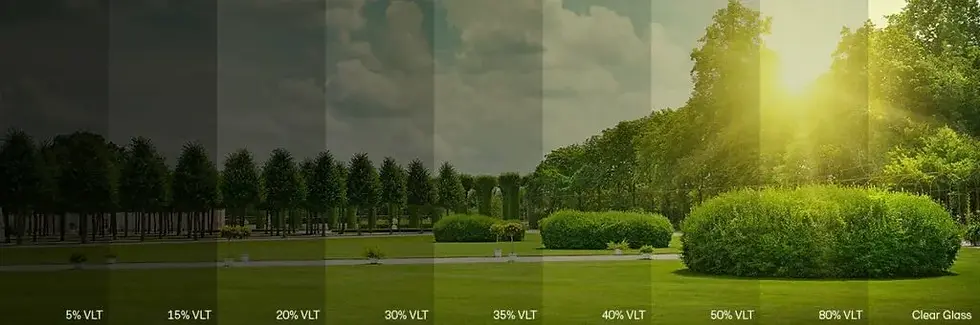
What is VLT? (Visible Light Transmission)

VLT stands for "Visible Light Transmittance".
The higher the value → The more transparent
The lower the value → The darker
For example:
70% = Extremely Transparent
35% = Medium Depth
20% = Dark Privacy
5% = Limousine Privacy Level
The legal judgment in New York is entirely based on the VLT standard.
1. Front Window: Must be ≥ 70% VLT
This is New York's most fundamental and stringent regulation. The front side windows must achieve a light transmission rate of 70% or higher. Any tint applied to the front windscreen with a light transmission rate of 50%, 35%, or 20% constitutes a violation. This value is measured during the annual inspection, so there is no chance of passing by fluke.
2. Rear Side Windows: No VLT Restrictions
The rear side windows can be of any depth, including 35%, 20%, 5% (limousine tint). However, the vehicle must be equipped with left and right rearview mirrors. This is the key condition for New York to relax the rear window depth restrictions.
3. Rear Windshield: No VLT Limitation
There is no minimum light transmittance requirement for the rear windshield either. As long as the vehicle has dual side exterior mirrors, either 20% or 5% is a legal option.
4. Front Windshield: Only AS-1 strip is permitted
The front windshield must not have dark films applied to it. The only exception is the narrow strip area above the AS-1 line. If there is no AS-1 marking on the glass, it shall be considered to be within 5 inches from the upper edge.
5. Annual inspection will mandate the measurement of the front window VLT
The annual inspection in New York State uses a photometer to measure the front window.
Below 70% → Direct failure
After failure → Must remove the membrane, reinstall it, and recheck
Many car owners only discovered on the day of the annual inspection that the sticker on the front window was too thick. Therefore, it is crucial to measure it in advance.
How Dark Can I Tint My Windows in New York?
The following examples utilise the four most common depths found in New York. This allows you to instantly determine which are suitable for front windows, which are restricted to rear windows, and the overall appearance they will present.

VLT Level | Front Windows | Rear Side Windows | Rear Windshield | Visibility Characteristics |
70% | ✔ Legal | ✔ Legal | ✔ Legal | Very clear; compliant with strong heat rejection |
35% | ✘ Illegal | ✔ Legal | ✔ Legal | Medium darkness; most common rear setup |
20% | ✘ Illegal | ✔ Legal | ✔ Legal | High privacy; darker at night |
5% | ✘ Illegal | ✔ Legal | ✔ Legal | Very dark; limousine-level privacy |
70% VLT (The only legal option for the front window)
70% is very close to transparency, yet it can still offer significant heat insulation by relying on ceramic membranes or nano-ceramic membranes. It is suitable for:
All car owners in New York; Those who frequently drive in Manhattan, Queens, and Brooklyn; Owners who wish to pass the annual inspection and avoid traffic tickets;
This is the "only depth" for the front window as required by the New York regulations. There are no exceptions.
35% VLT (The most common depth found in the rear section of New York)
35% is the most classic medium intensity. The color becomes darker, but it does not affect the visibility during the day. It is suitable for:
Rear side window
Rear windshield
Family cars or SUVs that aim to maintain a balanced appearance
But be aware: Placing it on the front window will be 100% illegal and will definitely result in a failed annual inspection.
20% VLT (High Privacy Depth)
20% significantly enhances privacy. It is almost impossible to see inside the vehicle from outside. Suitable for:
Car owners who want to enhance privacy
Users of Uber, Lyft or those who frequently park in public garages
Rear areas that require stronger visual concealment
It can only be used in the rear seats. Using it in the front window would be a violation.
5% VLT (Limousine Tint, Extremely Dark)
5% is the darkest level, often referred to as "limousine tint". It is almost completely invisible from the outside. Suitable for:
The rear seats of SUVs / MPVs
Owners with extremely high privacy requirements
However, it should be noted that: The 5% window on the front of the car is absolutely illegal in New York.
Does Dark Tint Affect NY Inspection?
Dark window tinting directly impacts the outcome of New York State (NYS) annual vehicle inspections, particularly for front windows. The NYS inspection utilises a professional photometer to measure the light transmission ratio (VLT) of front side windows, rather than relying on visual assessment. Should the test result fall below 70% VLT, the inspection will immediately be deemed failed, and the vehicle will not receive the annual inspection sticker. Regardless of whether the owner perceives the tint as "not particularly dark," the photometer's data constitutes the sole criterion.
If the annual inspection fails, the owner must remove the tinted film on the front window, reapply a compliant window film with a 70% light transmittance, and then return to the inspection station for re-inspection. This will result in additional time and cost losses. Many owners in Flushing only realized on the day of the annual inspection that the tinting was too deep because some contractors did not proactively inform about the regulations and did not measure the light transmittance of the original glass beforehand.
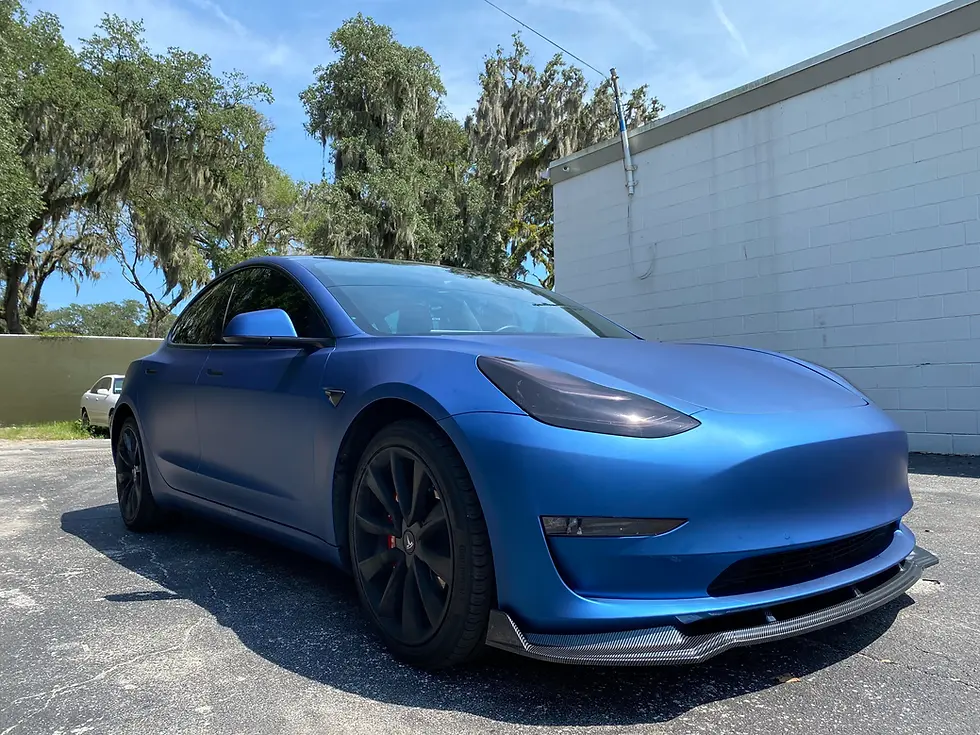
It should be particularly noted that the original factory VLT of Tesla's front window is slightly lower, and it is more likely to fall below the 70% regulatory standard after the film is applied. After many Tesla owners choose ceramic films, the VLT of the front window may drop to around 65%, thus being judged as unqualified during the annual inspection. Therefore, Tesla owners must have a VLT measurement conducted by a professional store before applying the film in New York to ensure that it remains legal after application.

The greatest challenge in window tinting in New York is maintaining a 70% visible light transmission (VLT) rating for the front windscreen. Many motorists worry this will make the vehicle appear "less cohesive". However, by selecting the correct film material and tint density, it is entirely possible to achieve compliance, an aesthetically pleasing result, and highly effective heat rejection.
The front window is equipped with a 70% transparent ceramic film: it complies with regulations and has a remarkable heat insulation effect.
Although 70% appears almost transparent, the heat insulation of modern ceramic membranes does not rely on color but on the material structure. High-grade ceramic membranes and nano ceramic membranes can significantly reduce infrared rays and heat. Even with a high transparency of 70%, the heat insulation effect is still much better than any dark-colored tinted membrane. This not only complies with New York regulations but also effectively reduces the interior temperature in summer, making it the most balanced choice.
Use a depth of 20-35% for the back row: maintain overall visual harmony
Since there is no light transmission restriction in the rear section, the depth can be selected from 20% to 35% according to aesthetic and privacy requirements.
35%: Natural and not abrupt. Family cars are the most common.
20%: Provides stronger privacy. SUVs and Teslas are commonly used.
The front window remains transparent, but the rear window becomes darker, creating a visual effect of "uneven contrast". Overall, it is both neat and tidy and complies with regulatory requirements.
The insulation effect mainly depends on the membrane material, rather than its color depth.
Many car owners mistakenly believe that "the deeper the color, the better the heat insulation." In fact:
The colored film relies on color to absorb light and has poor heat insulation performance.
The ceramic film relies on blocking infrared rays. Even when transparent, it has strong heat insulation properties.
This means that the front window is coated with a transparent ceramic film, while the rear window is coated with a film that is 20-35% thick. This allows for an almost uniform cooling effect throughout the entire vehicle while remaining legal.
The heat insulation effect of transparent ceramic membranes is much stronger than that of darkly tinted membranes
The dark tinted film gives the impression of "being very light-blocking", but its heat insulation ability is usually relatively weak. Modern high-grade nano-ceramic films can block a large amount of heat energy, and even in the high-transparency version, they can maintain stable heat insulation performance. This is why many high-end car owners and Tesla owners choose transparent ceramic films as the preferred configuration for the front windows in New York.
Why T-House Is a Trusted Choice for Legal Tint in New York
Brand Training Technician (with background in 3M / XPEL / Llumar) The technician has received official training from mainstream membrane brands, and thus has a better understanding of the VLT values, construction requirements and compatible vehicle models of different membrane materials. This reduces the risk of "discovering non-compliance after the installation".
Before starting the construction, measure the VLT (Vertical Lateral Tilt) to ensure the legal depth Before applying the film, first measure the light transmittance of the original factory glass with an instrument, then select the appropriate film; after installation, the actual VLT (Vehicle Light Transmittance) is more controllable, allowing car owners to use it with peace of mind within the 70% compliance range.
Familiar with high-end models such as Tesla, BMW, and Mercedes With practical experience in designing Tesla's large curved rear glass, German-style thick glass, and complex door panel structures, this design can balance aesthetics, insulation, and compliance with regulations.
Dust-free and constant-temperature construction room Reduce dust, bubbles and optical flaws, ensuring that the high-transparency front window remains clear and clean even at 70% of its maximum transparency, without affecting the driver's field of vision.
The quotations are transparent and there is no forced upgrade During the quotation stage, clearly state the membrane material grade, the additional difficulty of the vehicle model and the possible costs. This will prevent sudden price increases during the construction process and enhance the sense of trust.
Flushing's convenient location makes annual inspections easier Located in Flushing, close to the main road and the expressway, the owner can come for inspection or adjustment of the front window depth before or after the annual inspection, thus saving time and costs.
FAQ: Common Questions About Legal Tint in New York
Q1. How dark can I tint my front windows in NY?
The front window must maintain a visible light transmission (VLT) of ≥70%. Any tint exceeding this value is unlawful.
Q2. Is 35% legal in New York?
Rear window tinting is permitted, but front window tinting is not. 35% tint may only be applied to rear side windows and the rear windscreen.
Q3. Can cops pull me over for tint?
Yes. If the front windscreen is excessively tinted, preventing clear visibility of the driver's face, police officers may lawfully stop and inspect the vehicle.
Q4. Does 50% tint pass inspection?
Generally not. At 50%, it falls below the 70% requirement for New York front windows, so the annual inspection will fail.

If you want to enhance insulation and improve the appearance while ensuring full compliance, the most important thing is to confirm the original light transmittance of the vehicle and the final VLT that can be achieved before applying the film. T-House offers fast and transparent online consultation. You can first obtain a legal quote for the film application, or make an appointment to have the VLT measurement of the front windows conducted at the store. The technicians will provide professional advice based on New York regulations, your daily driving area and the structure of your vehicle model, and assist you in choosing the most suitable combination of front and rear window depths.
All processes are clear and transparent, without any mandatory upgrades or additional projects. You can decide whether to proceed with the installation after understanding the regulations and clarifying the requirements. This way, installing the film becomes a simple, safe, and non-disruptive option that won't affect the annual inspection.
📍Address :
15-45 128th Street,
Flushing, New York
United States
📩 E-mail :thouseny1@gmail.com
📞 Telephone : (845) 501-3559
🌐 Website: https://www.thouseny.com/


Comments